
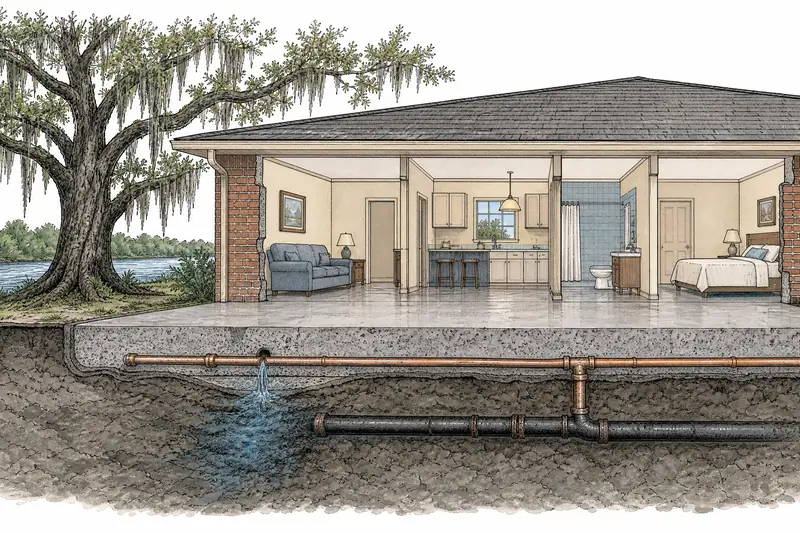
Illustration
Slab House Plumbing and City Water in the Gulf South
Slab house plumbing in the Gulf South fails in predictable ways: pipes under the concrete, sewer lines in sinking soil, aging water heaters. These guides explain each one, plus what the 2025 water reports say.
By the Below the Slab editors · Updated
This site is a homeowner information guide. It is not a plumbing company.
Start here
 Slab leaksWhat is a slab leak?
 Slab leaksSlab leak signs
 Slab leaksSlab leak repair cost
 Sewer & drainsSewer line replacement cost
 Sewer & drainsSewer camera inspection
 Water heatersHow long water heaters last
 New Orleans & Jefferson Parish waterIs New Orleans tap water safe?
 New Orleans & Jefferson Parish waterBoil water advisories
Key takeaways
- Most slab houses in the region run water supply and drain lines through or under the concrete, so a leak or a sag is out of sight; slab leak signs explains what to look for first.
- NASA's Jet Propulsion Laboratory measured parts of the New Orleans area sinking up to 2 inches a year (Michoud, 2016 study), which strains pipes that cross the slab edge.
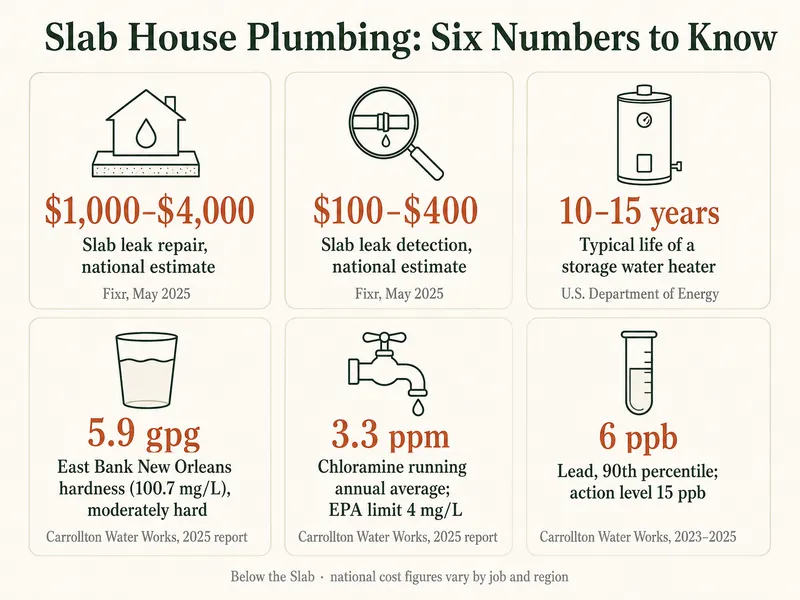
- Fixr's national estimate for slab leak repair is $1,000 to $4,000 (updated May 2025); local quotes vary with access, floor coverings and pipe length.
- The U.S. Department of Energy puts the life of a storage water heater at 10 to 15 years.
- Carrollton Water Works (East Bank New Orleans) reported total hardness of 100.7 mg/L, about 5.9 grains per gallon in its 2025 report: moderately hard, so a softener is optional.
- Homeowners policies in Louisiana exclude flood, sewer backup and earth movement unless endorsed, per the Louisiana Department of Insurance.
Slab house plumbing by the numbers
- 2 in/yrHighest sinking rate measured in the New Orleans area (Michoud)NASA JPL, 2016
- $1,000–$4,000National estimate for slab leak repair, updated May 2025Fixr
- 10–15 yearsTypical life of a storage water heaterU.S. Department of Energy, Energy Saver
- 100.7 mg/LTotal hardness at Carrollton Water Works in 2025, near 5.9 gpgLouisiana Department of Health, 2025 Carrollton report
- 3.3 ppmChloramine, highest running annual average, Carrollton 2025 (EPA limit 4 mg/L)LDH 2025 water quality report
What goes wrong under a slab house?
Under a slab house, three things go wrong most often: a pressurized water line leaks inside or below the concrete, a drain or sewer line cracks or sags, or the house itself shifts and pulls on the pipes. All three happen where nobody can see them. The first clue is usually indirect, such as a water bill that climbs, a warm patch of floor, a hissing sound with every tap closed, or a drain that keeps backing up.
A slab leak on the supply side wastes water around the clock because the line is always under pressure. A drain leak only runs when water goes down the drain, so it can soak the soil for months before anything shows. The first step is to confirm a leak exists, which slab leak detection covers, before anyone breaks concrete. Once a leak is confirmed, the choice is between a spot repair through the floor, a tunnel from outside, or abandoning the old line in favor of new piping routed overhead.
| Problem | Typical first clue | Guide to read |
|---|---|---|
| Supply-line slab leak | Water meter moves with every fixture off | Slab leak signs |
| Drain or sewer sag (belly) | Slow drains and repeat clogs in the same line | Sewer line belly |
| Old fiber sewer pipe | Line flattens or collapses in a 1950s–1970s house | Orangeburg pipe |
| Tree roots | Gurgling and backups that return after cleaning | Tree roots in a sewer line |
| Aging tank water heater | Rumbling, rusty hot water, a tank past 10 years | How long water heaters last |
| Boil water advisory | Notice from the utility after a pressure drop | Boil water advisory |
Why do Gulf South soils break slab plumbing?
Gulf South soils break slab plumbing because they move: soft delta ground subsides, and clay soils swell when wet and shrink when dry. A concrete slab can ride those movements, but the pipes running through it and out under the footing are fixed at the street end. When the house and the soil move differently, joints pull apart and rigid lines crack.
The NASA JPL study of May 2016 found sinking of up to 2 inches a year at Michoud and up to 1.6 inches a year behind the Bonnet Carré Spillway, with "notable subsidence" in Metairie and the Upper and Lower 9th Ward. It named groundwater pumping and dewatering as main causes. Swelling clay is a statewide problem too: an LSU team modeled the average annual property loss from expansive soils in Louisiana at about $66 million (2010 dollars). Foundation settlement and plumbing explains how that movement shows up in pipes and what to ask an engineer.
What happens to sewer lines under a settling house?
Sewer lines under a settling house tend to sag, separate at joints, or let roots in. A drain line needs a steady downhill slope; when the soil beneath one section sinks, the pipe forms a low spot that holds water and waste. Solids settle there and clogs keep returning.
Pipe material matters as much as soil. The City of Ann Arbor describes Orangeburg pipe, made of fiber soaked in tar, as installed from roughly the early 1950s to the early 1970s; it flattens under earth pressure as it ages. A 2001 review by Randrup, McPherson and Costello, hosted by the U.S. Forest Service, notes that roots are reported to cause more than half of all sewer blockages, mostly in older jointed pipe. A sewer camera inspection is the usual way to tell a belly from a root intrusion or a collapse, and the footage shapes the sewer line replacement cost.
How long does a water heater last on river water?
A tank water heater lasts about 10 to 15 years, according to the U.S. Department of Energy's Energy Saver guidance. New Orleans tap water comes from the Mississippi River and is treated to drinking standards, and at 5.9 grains per gallon on the East Bank it is moderately hard rather than very hard. That means some sediment and scale build up over time, but the 2025 report gives no reason to expect unusually short heater life.
Maintenance helps more than water chemistry. The Department of Energy suggests draining about a quart from a storage tank every three months; makers such as A. O. Smith call for a full drain and flush every six months in their gas heater manual. Follow the manual for your model. Water heater flush walks through the steps, and water heater replacement cost covers the national price ranges when a tank does reach the end.
What is in New Orleans and Jefferson Parish tap water?
New Orleans and Jefferson Parish tap water is treated Mississippi River water, disinfected with chloramine and tested against federal limits each year. The 2025 report for Carrollton Water Works (East Bank New Orleans) lists chloramine at a highest running annual average of 3.3 ppm, under the EPA limit of 4 mg/L, and lead at a 90th percentile of 6 ppb for 2023 to 2025, with 2 sampled sites over the 15 ppb action level.
The West Bank figures differ by plant. Algiers Water Works reported hardness of 70.7 mg/L (about 4.1 gpg), and the West Jefferson system reported 81 mg/L (about 4.7 gpg). East Jefferson's 2025 figures are in the parish's own report, which could not be opened for this site, so no number appears here. Is New Orleans tap water safe? goes through the report line by line, and New Orleans water hardness compares the plants. For short outages and pressure drops, the boil water advisory guide covers what to do at home.
Which plumbing jobs need a licensed plumber and a permit?
In New Orleans, removing or replacing any water piping or plumbing fixture needs a permit, and the application has to come from a master plumber licensed in Orleans Parish, according to the City of New Orleans permit guidelines. Plumbing permits there come from the Sewerage and Water Board, not the Department of Safety and Permits. Slab leak repairs, reroutes, sewer replacements and water heater swaps all fall under that rule.
The State Plumbing Board of Louisiana licenses apprentices, residential plumbers, journeymen and master plumbers, with a separate endorsement for backflow testing. The old Louisiana State Plumbing Code was voided at the start of 2016; plumbing now falls under the state's uniform construction code, which adopts the International Plumbing Code with amendments. Louisiana plumbing code explains what changed, and backflow prevention covers the yearly test some homes need. The full list of topics is on the guides page.
How we put this page together
This page summarizes the guides on this site. Local water numbers are taken from the state health department's posted 2025 reports (Carrollton, Algiers, West Jefferson); soil figures from NASA JPL and an LSU study; insurance wording from the Louisiana Department of Insurance; permit rules from the City of New Orleans; and water heater figures from the U.S. Department of Energy and an A. O. Smith manual, checked October 2026. Repair prices are Fixr's dated national ranges rather than quotes from local firms. Not included: East Jefferson water numbers (the report could not be opened), contractor price lists and forum anecdotes.
Common questions
Is a slab house more likely to have plumbing problems than a raised house?
Not necessarily more problems, but harder ones to reach. On a raised house the pipes run in a crawl space a plumber can walk to; on a slab they run in or under concrete, so finding and reaching a leak takes detection work and either cutting the floor or tunneling.
What should be checked first when a slab leak is suspected?
Turn off every fixture and watch the water meter. If the meter still moves, water is leaving the system somewhere, and a licensed plumber can use pressure tests and acoustic or thermal tools to narrow it down before any concrete is cut.
Does sinking ground in New Orleans affect every house the same way?
No. The 2016 NASA JPL study found rates that vary by area, with the fastest at Michoud and behind the Bonnet Carré Spillway. When floor cracks and plumbing problems appear together, a structural engineer can say whether the house is still moving.
Will homeowners insurance pay for slab plumbing repairs?
It depends on the policy wording. The Louisiana Department of Insurance guide says policies exclude flood, sewer backup and earth movement, while broad-form coverage includes accidental discharge from plumbing. Ask the insurer in writing whether access or tear-out costs are covered.
Is East Bank New Orleans tap water hard enough to need a softener?
At 100.7 mg/L (about 5.9 gpg) in the 2025 Carrollton report, it is moderately hard on the USGS scale. A softener is a comfort choice that can reduce spotting and scale, not a requirement.
Can a home filter prevent a boil water advisory problem?
No. Advisories follow pressure loss or distribution problems, and no home filter, softener or reverse osmosis unit is a substitute for boiling or following the utility's notice. Use the city's NOLA Ready page for current advisories.
Who can pull a plumbing permit in New Orleans?
According to the City of New Orleans permit guidelines, the applicant must be a master plumber holding an Orleans Parish license, and the permit is issued by the Sewerage and Water Board. Ask any contractor to confirm the permit before work starts.